MatricesMedium
Question
Let A, B & C are three matrices such that
A = , B = , C =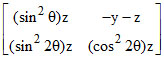
If there exist three real numbers x, y, z (not all zero simultaneously) for which A + B + C = O (null matrix), then θ can be equal to -
A =
, B = , C = If there exist three real numbers x, y, z (not all zero simultaneously) for which A + B + C = O (null matrix), then θ can be equal to -
Options
A.
B.
C.
D.π
Solution
A + B + C = 0
⇒ x + (sinθ)y + (sin2θ)z = 0
x + (sin 2θ)y + (sin22θ)z = 0
x + (cos 2θ)y + (cos22θ)z = 0
have non trivial solution
∴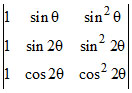 = 0
= 0
⇒ (sinθ - sin2θ) (sin2θ - cos2θ)(cos2θ - sinθ) = 0
⇒ sinθ(1 - 2cosθ) (sin2θ - cos2θ)
(1 + sinθ) (1 - 2sinθ) = 0
⇒ x + (sinθ)y + (sin2θ)z = 0
x + (sin 2θ)y + (sin22θ)z = 0
x + (cos 2θ)y + (cos22θ)z = 0
have non trivial solution
∴
= 0⇒ (sinθ - sin2θ) (sin2θ - cos2θ)(cos2θ - sinθ) = 0
⇒ sinθ(1 - 2cosθ) (sin2θ - cos2θ)
(1 + sinθ) (1 - 2sinθ) = 0
Create a free account to view solution
View Solution Free