Application of DerivativeMedium
Question
For function f(x) = esinx - e-sinx, which of the following is/are correct -
Options
A.Equation of normal at x = π is x - 2y = π
B.f(x) is strictly increasing ∀ x ∈ 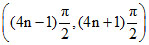 ; n ∈ I
; n ∈ IC.f(x) is strictly decreasing ∀ x ∈ 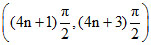 ; n ∈ I
; n ∈ ID.x = nπ, n∈I is either point of local maxima or minima of f(x).
Solution
y = f(x) = esinx - e-sinx
⇒ f′(x) = cosx(esinx + e-sinx)
f′(π) = - 2
⇒ slope of normal at x = π is
⇒ Equation of normal at x = π
⇒ x = 2y = π
sign of f′(x)
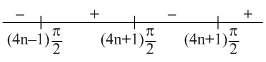
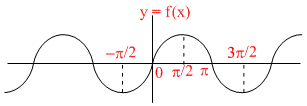
x = nπ is neither point of local maxima nor minima
⇒ f′(x) = cosx(esinx + e-sinx)
f′(π) = - 2
⇒ slope of normal at x = π is
⇒ Equation of normal at x = π
⇒ x = 2y = π
sign of f′(x)
x = nπ is neither point of local maxima nor minima
Create a free account to view solution
View Solution FreeMore Application of Derivative Questions
The function f(x) = x(x + 3)e-x/2 satisfies all the conditions of Rolle′s theorem on [-3, 0]. The value of c which...Equation of the normal to the curve y = - √x + 2 at the point of its intersection with the curve y = tan (tan-1 x)...A tangent drawn to the curve y = f(x) at P(x, y) cuts the x-axis and y-axis at A and B respectively such that BP : AP = ...The equation of normal to the curve y2 = 16x at the point (1, 4) is-...Let f(x) = Equation of tangent line touching both branches of y = f(x) is...