Math miscellaneousMedium
Question
If f(x + y) = f(x)f(y) ∀ x, y ∈ R and f(0) ≠ 0 and F(x) =  , then
  F(x) dx -
  F(x)dx is equal to -
, then F(x) dx - F(x)dx is equal to - Options
A. F(x)dx
F(x)dxB.0
C.F(x)dx
F(x)dxD. F(x)dx
F(x)dxSolution
f(x + y) = f(x)f(y) ⇒ f(x) = ax;
F(x) =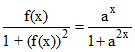 ⇒ F(x) = F(-x)
∴ F(x)dx -
  f(x) dx -
  f(x)dx =
  f(x)dx
F(x) =
⇒ F(x) = F(-x)∴
F(x)dx - f(x) dx - f(x)dx = f(x)dxCreate a free account to view solution
View Solution FreeMore Math miscellaneous Questions
If I1 = 2x2 dx, I2, = 2x3 dx, I32x2dx and I4 = 223 dx then...Let L = 2C0 + C2 + ..... + . Cn (where Cr = nCr). If S = , then which of the following is/are incorrect ?...If D = for x ≠ 0, y ≠ 0 then D is...If , then the smallest possible value of (a + b + c + d) if a, b, c, d are all positive integers -...Three forces and acting along IA, IB and IC, where I is the incentre of a ᐃABC, are in equilibrium. Then is...