Wave motionMedium
Question
Following are equations of four waves :
(i) 1 = a sin ω (ii) y2 = a cos ω
(iii) z1 = a sin ω (iv) z2 = a cos ω
Which of the following statements is/are CORRECT?
(i) 1 = a sin ω
(ii) y2 = a cos ω(iii) z1 = a sin ω
(iv) z2 = a cos ωWhich of the following statements is/are CORRECT?
Options
A.On superposition of waves (i) and (iii), a travelling wave having amplitude a√2 will be formed.
B.Superposition of waves (ii) and (iii) is not possible.
C.On superposition of waves (i) and (ii), a transverse stationary wave having maximum amplitude a√2 will be formed.
D.On superposition of waves (iii) and (iv), a transverse stationary wave will be formed.
Solution
Superposition of waves (i) & (iii) will give traveling wave having amplitude of a√2
{waves are along x-axis but particle displacements are along y & z-axis respectively}
z1 + z2 = a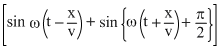
{waves are along x-axis but particle displacements are along y & z-axis respectively}
z1 + z2 = a
Create a free account to view solution
View Solution FreeMore Wave motion Questions
The tension in a piano wire is 10N. The tension in a piano wire to produce a node of double frequency is:...A travelling wave in a stretched string is described by the equation ; y = A sin(kx - ωt). The maximum particle vel...A string is stretched between fixed points separated by 75.0 cm. It is observed to have resonant frequncies of 420 Hz an...A copper wire is fixed between two rigid supports. It is stretched with negligible tension at 30oC. The speed of transve...The equation of a travelling wave is y = 60 cos (1800t - 6x) where y is in microns, t in second and x in metre. The rati...