Chemical Kinetics and Nuclear ChemistryMedium
Question
The first order rate constant for a certain reaction increase from 1.667 × 10⁻⁶ s-1 at 727oC to 1.66 × 10⁻⁴s-1 at 1571oC. The rate constant at 1150oC assuming constancy of activation energy over the given temprature range is
[Given : log 19.9 = 1.299][2009]
[Given : log 19.9 = 1.299][2009]
Options
A.3.911 × 10-5s-1
B.1.139 × 10-5s-1
C.3.318 × 10-5s-1
D.1.193 × 10-5s-1
Solution
log 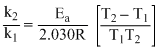
or 2.030 log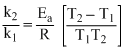
2.030 log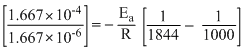
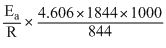
2.030 × 2 =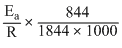 .......(1)
∴
2.030log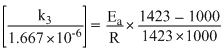
=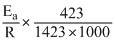 ......(2)
Dividing equation (2)by equation (1)
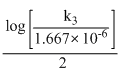
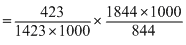
∴ log
2 × = 1.299
On taking Antilog., k3 = 19.9
∴ k3 = 19.9 × 1.667 × 10-6 = 3.318 × 10⁻⁵s-1
or 2.030 log
2.030 log
2.030 × 2 =
.......(1)∴
2.030log
=
......(2)Dividing equation (2)by equation (1)
∴ log
2 ×
= 1.299On taking Antilog., k3 = 19.9
∴ k3 = 19.9 × 1.667 × 10-6 = 3.318 × 10⁻⁵s-1
Create a free account to view solution
View Solution FreeTopic: Chemical Kinetics and Nuclear Chemistry·Practice all Chemical Kinetics and Nuclear Chemistry questions
More Chemical Kinetics and Nuclear Chemistry Questions
Consider the first order reaction $R \rightarrow P$.The fraction of molecules decomposed in the given first order reacti...At room temperature, the reaction between NO and O2 to give NO2 is fast, while that between CO and O2 is slow. It is due...For the reactions of first, second and third orders, K1 = K2 = K3, where concentrations are expressed in ‘M’. The correc...Aqueous ammonia can be used to separate which of the following pair of ions ?...Consider the following reactions. $A\overset{\quad K_{1} = 6.93 \times 10^{- 2}\text{ mi}\text{n}^{- 1}\quad}{\rightarro...