Magnetic field due to currentMedium
Question
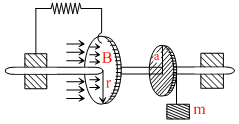
A metallic disc of radius r is made of a material of negligible resistance and can rotate about a conducting horizontal shaft. A smaller non conducting disc of radius a is fixed onto the same shaft and has a massless cord wrapped around it, which is attached to a small object of mass m as shown. Two ends of a resistor of resistance R are connected to the perimeter of the disc and to the shaft by sliding contacts. The system is then placed into a uniform horizontal magnetic field B and the mass m is released. Find the terminal angular velocity with which the disc will rotate finally.
(Take r = 10 cm, a = 2 cm, R = Ω, B = 0.2 T, m = 50 gm, g = 10 m/s2)
(Take r = 10 cm, a = 2 cm, R =
Ω, B = 0.2 T, m = 50 gm, g = 10 m/s2)Options
A.200 rad/s
B.300 rad/s
C.100 rad/s
D.10 rad/s
Solution
At terminal stage, torque applied on smaller disc by rope = mga
current to the disc = (where ω is terminal angular velcity)
torque applied by magnetic field =
So, = mga
ω = 100 rad/sec
current to the disc =
(where ω is terminal angular velcity) torque applied by magnetic field =
So,
= mgaω = 100 rad/sec
Create a free account to view solution
View Solution FreeMore Magnetic field due to current Questions
Two very long straight parallel wires carry steady state currents I and - I rexpectively. The distance between the wires...A 1 m long metal rod AB completes the circuit as shown in figure. The area of circuit is perpendicular to the magnetic f...Two concentric coils each of radius equal to 2π cm are placed at right angles to each other. 3 Ampere and 4 ampere ...wo particles A and B of masses mA and mB respectively and having the same charge are moving in a plane. A uniform magnet...Two conducting rings P and Q of radius r and 3r moves in opposite direction with velocities 2v and v respectively on a c...