Math miscellaneousMedium
Question
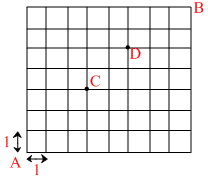
A person wants to reach from A to B by moving upward or rightward direction only taking one unit step at time, then number of shortest path available to him if he must pass through C but not through D -
Options
A.2520
B.1200
C.1320
D.1560
Solution
Total number of desired paths =
(A → C, C → B) – (A → C, C → D, D → B)
⇒ 6C3. 9C4 - 6C3.4C2.5C2 = 1320
(A → C, C → B) – (A → C, C → D, D → B)
⇒ 6C3. 9C4 - 6C3.4C2.5C2 = 1320
Create a free account to view solution
View Solution FreeMore Math miscellaneous Questions
The number of terms in the expansion of , which are integers is:-...Number of solution(s) of the equation = 8 in θ ∈[0, π] is...If , then k is equal to :...Let Tr be the rth term of an A.P. whose first term is a and common difference is d. If for some positive integers m, n, ...The remainder left out when 82n - (62)2n + 1 is divided by 9 is...