JEE Advanced | 2014Quadratic EquationMedium
Question
The quadratic equation p(x) = 0 with real coefficients has purely imaginary roots. Then the equation p(p(x)) = 0 has
Options
A.Only purely imaginary roots
B.All real roots
C.Two real and two purely imaginary roots
D.Neither real nor purely imaginary roots
Solution
Let p(x) = x2 + a (a > 0) (∵ roots are purely imaginary)
p(p(x)) = (x2 + a)2 + a (a ∈ R)
x4 + 2a(x2) + a2 + a = 0
⇒ x2 =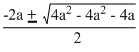
= - a +
x = + = x1 + iy1
p(p(x)) = (x2 + a)2 + a (a ∈ R)
x4 + 2a(x2) + a2 + a = 0
⇒ x2 =
= - a +
x = +
= x1 + iy1Create a free account to view solution
View Solution FreeMore Quadratic Equation Questions
Let p and q be real numbers such that p ≠ 0, P3 ≠ -q. If α and β are nonzero complex numbers satis...If α, β are the roots of ax2 + bx + c = 0; α + h, β + h are the roots of px2 + qx + r = 0, and D1, D...If $\alpha$ and $\beta$ are roots of the equation $ax^{2} + bx + c = 0$, then the roots of the equation ${ax}^{2} - bx(x...The possible values of ' $b$ ', $b \in R$ for which the equations $2017x^{2} + bx + 7102 = 0$ and $7102x^{2} + bx + 2017...The quadratic equation with one root is-...