Physics miscellaneousMedium
Question
A glass tube of uniform internal radius (r) has a valve separating the two identical ends. Initially, the valve is in a tightly closed position. End 1 has a hemispherical soap bubble of radius r. End 2 has sub-hemispherical soap bubble as shown in figure. Just after opening the valve,
Figure:
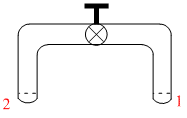
Figure:
Options
A.air from end 1 flows towards end 2. No change in the volume of the soap bubbles
B.air from end 1 flows towards end 2. Volume of the soap bubble at end 1 decreases
C.no changes occurs
D.air from end 2 flows towards end 1. volume of the soap bubble at end 1 increases
Solution
P1 = pressure just inside the bubble at the end 2 = P0 + 
P2 = pressure just inside the bubble at the end 1 = P0 +
R > r ⇒ P2 < P1 ⇒ Air will flow from end 1 to end 2
P2 = pressure just inside the bubble at the end 1 = P0 +
R > r ⇒ P2 < P1 ⇒ Air will flow from end 1 to end 2
Create a free account to view solution
View Solution FreeMore Physics miscellaneous Questions
The value of the resistor, RS, needed in the dc voltage regulator circuit shown here, equals :...Thermodynamic processes are indicated in the following diagram : Match the following Column-1 Column-2 P. Process I a. A...At t = 0, particle is at rest. Then the maximum speed achieved by particle :-...Four charges are placed at corner of a rectangle. Which of the following is true at centre (O) :-...In the following circuit, when the switch is closed the bulb will not glow :-...