Set, Relation and FunctionMedium
Question
Let f(x) be a non-constant twice differentiable function defined on (- ∞, ∞) such that f(x) = f(1 - x) and f′  = 0. Then
= 0. ThenOptions
A.f′(x) vanishes at least twice on [0, 1]
B.f′ = 0
= 0
= 0C. sin x dx 0
sin x dx 0D. f(t)esin πt dt =
  f(1 - t)esin πt dt
f(t)esin πt dt = f(1 - t)esin πt dtSolution
f(x) = f(1 - x)
Put x = 1/2 + x
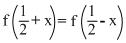
Hence f(x + 1/2) is an even function or f(x + 1/2) sin x is an odd function.
Also, f′ (x) = - f′(1 - x) and for x = 1/2, we have f′(1/ 2) = 0.
Alos, f(1 - t)esin πt dt = -
  f(y)esin πy dy (obtained by putting, 1 - t = y).
Since f′(1/4) = 0, f′(3/4) = 0. Also f′(1/2) = 0
⇒ f′′(x) = 0 atleast twice in [0, 1] (Rolle′s Theorem)
Put x = 1/2 + x
Hence f(x + 1/2) is an even function or f(x + 1/2) sin x is an odd function.
Also, f′ (x) = - f′(1 - x) and for x = 1/2, we have f′(1/ 2) = 0.
Alos,
f(1 - t)esin πt dt = - f(y)esin πy dy (obtained by putting, 1 - t = y).Since f′(1/4) = 0, f′(3/4) = 0. Also f′(1/2) = 0
⇒ f′′(x) = 0 atleast twice in [0, 1] (Rolle′s Theorem)
Create a free account to view solution
View Solution FreeMore Set, Relation and Function Questions
Let f: (-1, 1) → R be a differentiable function with f(0) = - 1 and f′(0) = 1. Let g(x) = [f(2f(x) + 2)]2. T...Given function f : R → R is defined by f(x) = .Which of the following holds good ?...Let R be the real line. Consider the following subsets of the plane R × R. S = {(x, y) : y = x + 1 and 0...Let f: → be a function given by f(x) = max(sinx, tan2x). Identify the correct statement(s) -...A function f(x) satisfies the relation f(x + y) = f(x) + f(y) + xy (x + y) ∀, x, y, ∈ R. If f′(0) = - ...