Quadratic EquationEasy
Question
If a > 0 discriminant of ax2 + 2bx + c is - ve, then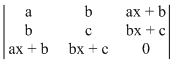 is
is
is Options
A.+ ve
B.(ac - b2) (ax2 + 2bx + c)
C.- ve
D.0
Solution
We have By R3 → R3 - (xR1 + R2) = 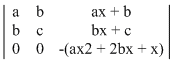
= (ax2 + 2bx + c) (b2 - ac) = (+) (-) = - ve
By R3 → R3 - (xR1 + R2) = = (ax2 + 2bx + c) (b2 - ac) = (+) (-) = - ve
Create a free account to view solution
View Solution FreeMore Quadratic Equation Questions
If α, β are roots of the equation px2 + qx − r = 0, then the value of is equal to -...The number of quadratic equations which are unchanged by squaring their roots are -...If roots of x2 − (a − 3)x + a = 0 are such that both of them is greater than 2, then-...The least value of the experssion 2 log10 x - logx (0.01),for x > 1, is...If α and β are roots of ax2 − bx + c = 0, then (α + 1) (β + 1) is equal to -...