Math miscellaneousEasy
Question
Let f(x) = 4 and f′(x) = 4. Then 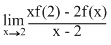 is given by
Options
A.2
B.-2
C.-4
D.3
Solution
We have, 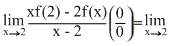 f(2) - 2f′(x) = f(2) - 2f′(2) = 4 - 2 × 4 = - 4
Create a free account to view solution
View Solution FreeMore Math miscellaneous Questions
Three forces and acting along IA, IB and IC, where I is the incentre of a ᐃABC, are in equilibrium. Then is...dx is equal to...If x = ey+ey+....to∞, x > 0, then is...Let f(x) = If f(x) is continuous in, then f is...If 2a + 3b + 6c =0, then at least one root of the equation ax2 + bx + c = 0 lies in the interval...