ProbabilityEasy
Question
Let E and F be two independent events. The probability that exactly one of them occurs is  and the probability of none of them occurring is
  . If P(T) denotes the probability of ocurrence of the event T, then
and the probability of none of them occurring is . If P(T) denotes the probability of ocurrence of the event T, thenOptions
A.P (E) = 4/5, P(F) = 3/5
B.P (E) = 1/5, P(F) = 2/5
C.P (E) = 2/5, P(F) = 1/5
D.P (E) = 3/5, P(F) = 4/5
Solution
Let P (E) = e and P (F) = f
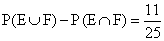
⇒ e + f - 2ef = ......(1)

⇒ (1 - e) (1 - f) =
⇒ 1 - e - f + ef = ......(2)
From (1) and (2)
ef = and e + f = 7/5.
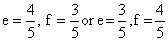
Solving, we get
⇒ e + f - 2ef =
......(1)⇒ (1 - e) (1 - f) =
⇒ 1 - e - f + ef =
......(2)From (1) and (2)
ef =
and e + f = 7/5.Solving, we get
Create a free account to view solution
View Solution FreeMore Probability Questions
There are two bags each containing 10 different books. A student draws out any number of books (at least one) from first...There are 13 men and 2 women in a party. They are seated round a circular table. The probability that the two women will...A bag contains 50 tickets numbered 1, 2, 3, ..., 50 of which five are drawn at random and arranged in ascending order of...A die is weighted so that the probability of different faces to turn up is as givenIf P(A/B) = p1 and P(B/C) = p2 and P(...Three numbers are selected one by one at random without replacement from the set of numbers $\{ 1,2,3,\ldots\ldots,n\}$....