FunctionEasy
Question
Let f : R → R be a function such that f (x + y) = f (x) + f (y), ∀ x, y ∈ R. If f(x) is is differeniable at x = 0, then
Options
A.f (x) is differentiable only in a finite interval containing zero
B.f (x) is continuous ∀ x ∈ R
C.f′ (x) is constant ∀ x ∈ R
D.f (x) is differentiable except at finitely many points
Solution
 f (0) = 0 and f′(x) =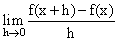
⇒
 = f′(0) = k (say)
⇒ f (x) = kx + c ⇒ f (x) = kx (
f (0) = 0).Create a free account to view solution
View Solution FreeMore Function Questions
Range of the function f(x) = sin2(x4) + cos2(x4) is-...Let $\lbrack t\rbrack$ denote the greatest integer less than or equal to $t$. If the function$$f(x) = \left\{ \begin{mat...Which of the following pair of functions are identical ?...Let $f:\lbrack 1,\infty) \rightarrow \mathbb{R}$ be a differentiable function, If$6\int_{1}^{x}\mspace{2mu} f(t)dt = 3xf...The range of f(x) = cos 2x − sin 2x contains the set -...