Trigonometric EquationEasy
Question
Let A and B be two events such thatP 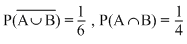 and P
and P  where
where  stands for complement of event A. Then events A and B are
and P where stands for complement of event A. Then events A and B areOptions
A.equally likely and mutually exclusive
B.equally likely but not independent
C.independent but not equally likely
D.mutually exclusive and independent
Solution
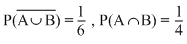 and
and 
⇒ P(A ∪ B) = 5/6 P(A) = 3/4
Also P(A ∪ B) = P(A) + P(B) - P(A ∩ B)
⇒ P(B) = 5/6 - 3/4 + 1/4 = 1/3
P(A) P(B) = 3/4 - 1/3 = 1/4 = P(A ∩ B)
Hence A and B are independent but not equally likely.
Create a free account to view solution
View Solution FreeMore Trigonometric Equation Questions
The value of the integral cos x dx is...Solution set of ′θ′ for which sin θ + √3 cos θ ≥ 1, -π < θ ≤ &...A bead of weight w can slide on smooth circular wire in a vertical plane. The bead is attached by a light thread to the ...The general solution ofsin x -3 sin 2x + sin 3x = cos x - 3 cos 2x + cos 3x is -...If α = 3 sin-1 and β = 3 cos-1 where the inverse trigonometric functions take only the principal values, then ...