Set, Relation and FunctionEasy
Question
If f is a real-valued differentiable function satisfying |f(x) – f(y)| ≤ (x - y)2, x, y ∈ R and f(0) = 0, then f(1) equals
Options
A.-1
B.0
C.2
D.1
Solution
f′(x) = 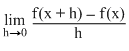
|f′(x)| =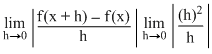
⇒ |f′(x) ≤ 0 ⇒ f′(x) = 0 ⇒ f(x) = constant
As f(0) = 0 ⇒ f(1) = 0.
|f′(x)| =
⇒ |f′(x) ≤ 0 ⇒ f′(x) = 0 ⇒ f(x) = constant
As f(0) = 0 ⇒ f(1) = 0.
Create a free account to view solution
View Solution FreeMore Set, Relation and Function Questions
For every integer n, let an and bn be real numbers. Let function f : IR → IR be given by f(x) = , for all integers...Let f be a twice differentiable function such that f″(x) = - f(x) and f′(x) = g(x). If h(x) = (f(x))2 + (g(x...Which of the following statement(s) is/are correct about continuous functions y = f(x) & y = g(x) ?...Let R = {(1, 3), (4, 2), (2, 4), (2, 3), (3, 1)} be a relation on the set A = {1, 2, 3, 4}. The relation R is -...f : R → R, f(x) = . If the range of this function is [-4, 3), Then find the value of |m + n| is :-...