Math miscellaneousEasy
Question
Suppose f(x) is differentiable x = 1 and 
 f(1 + h) = 5, then f′(1) equals
f(1 + h) = 5, then f′(1) equalsOptions
A.3
B.4
C.5
D.6
Solution
f′(x) = 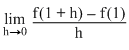 ; As function is differentiable so it is continuous as it is given
that = 5 and hence f(1) = 0
Hence f′(1) = = 5
= 5
Hence (3) is the correct answer.
; As function is differentiable so it is continuous as it is giventhat
= 5 and hence f(1) = 0 Hence f′(1) =
= 5Hence (3) is the correct answer.
Create a free account to view solution
View Solution FreeMore Math miscellaneous Questions
A body weighing 13 kg is suspended by two strings 5 m and 12 m long, their other ends being fastened to the extremities ...A factor is operating in two shifts, day and night, with 70 and 30 workers respectively. If per day mean wageof the day ...If , then k is equal to :...If A = then...If the expansion in powers of x is a0 + a1x + a2x2 + aa3x3 + ...., then an is...