ThermochemistryMedium
Question
The enthalpy changes for the following processes are listed below:
Cl2(g) = 2Cl(g), 242.3 kJ mol-1
I2(g) = 2I(g), 151.0 kJ mol-1
ICl(g) = I(g) + Cl(g), 211.3 kJ mol-1
I2(s) = I2(g), 62.76 kJ mol-1
Given that the standard states for iodine and chlorine are I2(s) and Cl2(g), the standard enthalpy of formation for ICl(g) is
Cl2(g) = 2Cl(g), 242.3 kJ mol-1
I2(g) = 2I(g), 151.0 kJ mol-1
ICl(g) = I(g) + Cl(g), 211.3 kJ mol-1
I2(s) = I2(g), 62.76 kJ mol-1
Given that the standard states for iodine and chlorine are I2(s) and Cl2(g), the standard enthalpy of formation for ICl(g) is
Options
A.-14.6 kJ mol-1
B.-16.8 kJ mol-1
C.+ 16.8 kJ mol-1
D.+ 244.8 kJ mol-1
Solution
 I2(S) + Cl2 → ICl(g)
ᐃH =
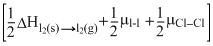 -[μI - Cl]
=
 - (211.3)
= 228.03 - 211.3
ᐃH = 16.73
Create a free account to view solution
View Solution FreeMore Thermochemistry Questions
Assume that for a domestic hot water supply, 160 kg of water per day must be heated from 10oC to 60oC and gaseous fuel p...The molar enthalpy of vaporization of benzene at its boiling point (353 K) is 7.4 kcal/mol. The molar internal energy ch...When 0.18 g of glucose was burnt in a bomb calorimeter, the temperature rose by 4 K. The heat capacity of the calorimete...When 1 g equivalent of strong acid reacts with strong base, the heat released is 13.5 kcal. When 1 g equivalent H2A is c...Given that :-CH4(g) + 300 kJ → C(g) + 4H(g)C2H6(g) + 620 kJ → 2C(g) + 6H(g)The value of C - C bond energy is...