ElectrostaticsMedium
Question
A charge Q is placed at each of the opposite corners of a square. A charge q is placed at each of the other two corners. If the net electrical force on Q is zero, then the Q/q equals
Options
A.-2√2
B.-1
C.1
D.
Solution
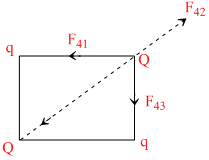
Three forces F41, F42 and f43 acting on Q are shown
Resultant of F41 + F43
= √2 Feach

Resultant on Q becomes zero only when ′q′ charges are of negative nature.
F4.2 =

⇒
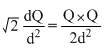
⇒ √2 × q =

∴ q = -
 or
or  = - 2√2
Create a free account to view solution
View Solution FreeMore Electrostatics Questions
Let there be a spherically symmetric charge distribution with charge density varying as ρ (r) = ρ0 upto r = R,...A horizontal electric field (E = (mg)/q) exists as shown in figure and a mass m attached at the end of a light rod. If m...The maximum electric field that can be held in air without producing sphere of resulting sphere of radius 0.10 m can be ...The dipole moment of a system of charge +q distributed uniformly on an arc of radius R subtending an angle π / 2 at...A charged particle ′q′ is shot from a large distance with speed v towards a fixed charged particle Q. It app...