JEE Advanced | 2018Area under the curveEasy
Question
Let ƒ : [0, ) be a continuous function such thatƒ(x) =1- 2x + ƒ(t)dt for all x [0, ). Then, which of the following statement(s) is (are) TRUE ?
Options
A.
The curve y = ƒ(x) passes through the point (1, 2)
B.
The curve y = ƒ(x) passes through the point (2, –1)
C.
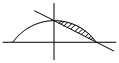
The area of the region
D.
The area of the region
Solution
ƒ(x) =
Differentiate w.r.t. x.
e-x ƒ(x) + e-x ƒ '(x) =-e-x (1- 2x) + e-x (-2) + e-x ƒ(x)
–ƒ(x) + ƒ'(x) = –(1 – 2x) – 2 + ƒ(x).
ƒ'(x) – 2ƒ(x) = 2x – 3
Integrating factor = e–2x.
ƒ(x).e–2x =(2x-3)dx
=(2x-3)(2x-3)dx
= 
Create a free account to view solution
View Solution FreeMore Area under the curve Questions
For which of the following values of m, is the area of the region bounded by the curve y = x - x2 and the line y = mx eq...The area bounded by the curve y = sin 2x, y-axis and the abscissa y = 1 is-...The area bounded by the curve y = x sin x2, x-axis and x = 0 and x = is-...The value of ′a′ (a > 0 ) for which the area bounded by the curves y = , y = 0, x = aand x = 2a has the l...The area of the figure bunded by the curves y = |x − 1| and y = 3 −|x| is -...