ProbabilityHard
Question
If  and
and  are the complementary events of E and F respectively and if 0 < P (F) < 1 . then
and are the complementary events of E and F respectively and if 0 < P (F) < 1 . then Options
A.P(E / F) + P( / F) = 1
/ F) = 1B.P(E / F) + P(E / ) = 1
) = 1C.P( / F) + P(E / ) = 1
/ F) + P(E / ) = 1D.P(E / ) + P( / ) = 1
) + P( / ) = 1Solution
(a) P(E / F) + P( / F)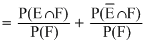
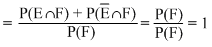
Therefore (a) is correct.
(b) P(E / F) + P(E /)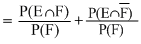
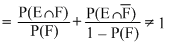
Therefore, (b) is not correct.
(c) P( / F) + P(E / ) = 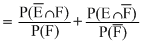
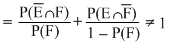
Therefore, (c) is not the answer.
(d) P(E /) + P( / )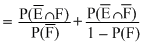
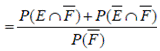
 = 1
= 1
Therefore, (d) is true.
So, (a), (d) are the answers.
/ F)Therefore (a) is correct.
(b) P(E / F) + P(E /
)Therefore, (b) is not correct.
(c) P(
/ F) + P(E / ) = Therefore, (c) is not the answer.
(d) P(E /
) + P( / )= 1Therefore, (d) is true.
So, (a), (d) are the answers.
Create a free account to view solution
View Solution FreeMore Probability Questions
If A1,A2,......,An are any n events, then-...In a horse race there are 18 horses numbered from 1 to 18. The probability that horse 1 would win is , horse 2 is and 3 ...Two dice are thrown together. The probability that the sum of their numbers be at least 5 is-...Consider the system of equations $ax + by = 0$ and $cx + dy = 0$ where $a,b,c,d \in \{ 1,2\}$. Then the probability that...Let P (A) = 0.4 and P (B/A) = 0.5. The probability P () is equal to-...