ProbabilityMedium
Question
For any two events A and B in a sample space
Options
A.P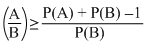 P(B) ≠ 0 is always true
P(B) ≠ 0 is always trueB.P(A ∩  ) = P(A) - P(A ∩ B) does not hold
) = P(A) - P(A ∩ B) does not holdC.P(A ∪ B) = 1- P( )P(
)P( ) if A and B are independent
)P() if A and B are independentD.P(A ∪ B) = 1- P()P() if A and B are disjoint
)P() if A and B are disjointSolution
We know that,
P
Since, P(A ∪ B) < 1
⇒ - P(A ∪ B) > - 1
⇒ P(A) + P(B) - P(A ∪ B) > P(A) + P(B) -1
⇒
⇒ P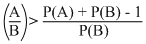
Option (a) is correct.
The choice (b) holds only for disjoint ie, P(A ∩ B) = 0
Finally, P(A ∪ B) = P(A) + P(B) - P(A ∩ B)
= P(A) + P(B) - P(A).P(B)
If A,B are independent
= 1 - {1 - P(A)} {1 - P(B)}
= 1 - P( ).P(
).P( )
)
∴ Option (c) is correct, but option (d) is not correct.
P
Since, P(A ∪ B) < 1
⇒ - P(A ∪ B) > - 1
⇒ P(A) + P(B) - P(A ∪ B) > P(A) + P(B) -1
⇒
⇒ P
Option (a) is correct.
The choice (b) holds only for disjoint ie, P(A ∩ B) = 0
Finally, P(A ∪ B) = P(A) + P(B) - P(A ∩ B)
= P(A) + P(B) - P(A).P(B)
If A,B are independent
= 1 - {1 - P(A)} {1 - P(B)}
= 1 - P(
).P()∴ Option (c) is correct, but option (d) is not correct.
Create a free account to view solution
View Solution FreeMore Probability Questions
A committee consists of 9 experts taken from three colleges, A, B and C; of which 2 are from A,3 from B and 4 from C. If...The chance of winning a test match by India against West indies is 1/2. A series of 5 test matches is played and the res...Let 0...A bag contains 4 tickets numbered 1, 2, 3, 4 and another bag contains 6 tickets numbered 2, 4, 6, 7, 8, 9. One bag is ch...7 persons are stopped on the road at random and asked about their birthdays. If the probability that 3 of them are born ...