FrictionMedium
Question
A block A (5 kg) rests over another block B (3 kg) placed over a smooth horizontal surface. There is friction between A and B. A horizontal force F1 gradually increasing from zero to a maximum is applied to A so that the blocks move together without relative motion. Instead of this another horizontal force F2, gradually increasing from zero to a maximum is applied to B so that the blocks move together without relative motion. Then
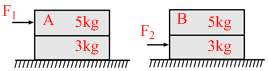
Options
A.F1 (max) = F2 (max)
B.F1 (max) > F2 (max)
C.F1 (max) < F2 (max)
D.F1 (max) : F2 (max) = 5 : 3
Solution
(B,D) Case I
Since, no relative motion
Ff is friction between A and B
a = ⇒ F1(max) =
  Ff
Ff
Case = II
a = ⇒ F2(max) =
  Ff
Ff
Clearly ; F1 (max) > F2 (max)
and
Since, no relative motion
Ff is friction between A and B
a =
⇒ F1(max) = FfCase = II
a =
⇒ F2(max) = FfClearly ; F1 (max) > F2 (max)
and
Create a free account to view solution
View Solution FreeMore Friction Questions
φ is the angle of the incline when a block of mass m just start slipping down. The distance covered by the block if...A uniform rope so lies on a table that part of it lays over. The rope begins to slide when the length of hanging part is...A block of mass m is lying on an inclined plane. The coefficient of friction between the plane and the block is μ. ...Having been paddled continuously on a horizontally road, the speed of a bicycle is increasing, the force of friction exe...A car starting from rest accelerates at the rate f through a distance s, then continues at constant speed for time t and...