ProbabilityHard
Question
Box-I contains 5 red and 4 blue balls while box-II contains 4 red and 2 blue balls. A fair die is thrown. If it turns up a multiple of 3, a ball is drawn from box-I, else a ball is drawn from box-II. Find the probabiliy of the event ′ball drawn is from box-I, if it is blue′.
Options
A.1/6
B.15/19
C.4/19
D.2/5
Solution
A → Ball from Box I, P(A) =  P(E/A) = 4/9
B → Ball from Box II P(B) = P(E/B) = 2/6
E → Ball drawn is Blue
By use of Bays theorem
P(A/E) =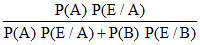
P(E/A) = 4/9B → Ball from Box II P(B) =
P(E/B) = 2/6E → Ball drawn is Blue
By use of Bays theorem
P(A/E) =
Create a free account to view solution
View Solution FreeMore Probability Questions
If at least one child in a family with 3 children is a boy then the probability that 2 of the children are boys, is -...The probability that A will pass in a examination is 2/5 and the probability that B will fail in the same examination is...In a maths paper there are 3 sections A, B & C. Section A is compulsory. Out of section B & C a student has to attempt a...A determinant is chosen at random from the set of all determinant of order 2 with elements 0 or 1 only. The probability ...A draws two cards one by one (replacing previous one) from a pack of cards and B throws two dice together. The probabili...