ProbabilityHard
Question
For any two events A & B defined on a sample space,
Options
A.P(A/B) ≥ 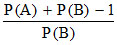 , P (B) ≠ 0 is always true
, P (B) ≠ 0 is always trueB.P = P(A) - P(A ∩ B)
= P(A) - P(A ∩ B)C.P(A ∪ B) = 1 - P (Ac). P (Bc), if A & B are independent
D.P(A ∪ B) = 1 - P (Ac). P (Bc), if A & B are disjoint
Solution
(A) P(A/B) = 

(B) P(A ∪ B) = P(A) + P(B) - P(A) P(B)
A & B are ind.
= P(A) (1 - P(B) + P(B)
= P(A) + P(B) + 1 - 1
= P(A) -
-  + 1
+ 1
⇒ 1 + (P(A) - 1) = 1 -
(B) P(A ∪ B) = P(A) + P(B) - P(A) P(B)
A & B are ind.
= P(A) (1 - P(B) + P(B)
= P(A)
+ P(B) + 1 - 1= P(A)
- + 1⇒ 1 +
(P(A) - 1) = 1 - Create a free account to view solution
View Solution FreeMore Probability Questions
The odds in favour of winning a race by three boys are 1:3, 1:5 and 1:4 respectively. The probability of winning the rac...A die is thrown a fixed number of times. If probability of getting even number 3 times is same as the probability of get...Two events A and B have probabilities 0.25 and 0.50 respectively. The probabilitity that both A and B occur simultaneous...A number is chosen at random from the numbers 10 to 99. A number whose product of digits is 12 will be called a good num...In a maths paper there are 3 sections A, B & C. Section A is compulsory. Out of section B & C a student has to attempt a...