DeterminantHard
Question
Let a, b, c positive numbers. The following system of equations in x, y and z.
 = 1 ;
= 1 ;  = 1 ; -
  = 1 has :
= 1 ; = 1 ; - = 1 has : Options
A.No solution
B.unique solution
C.infinitely many solution
D.finitely many solutions
Solution
ᐃ = 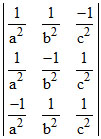 by R1 → R1 + R2, R2 → R2 + R3
ᐃ =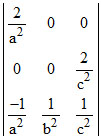
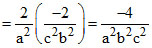
D ≠ 0 Here equations are of second degree so, more than one finite solution.
by R1 → R1 + R2, R2 → R2 + R3ᐃ =
D ≠ 0 Here equations are of second degree so, more than one finite solution.
Create a free account to view solution
View Solution FreeMore Determinant Questions
Suppose a1, a2, a3 are in A.P. and b1, b2, b3 are in H.P. and let ᐃ = , then...If AB = O for the matrices A = and B = then θ - φ is...If = a0 + a1 (sin x) + a2 (sin2x) + ........ + an (sinnx) then the value of a0 is -...Given that q2 - pr < 0, p > 0, then the value of is -...If f(x) = log10x and g(x) = eipx and h(x) = , then the value of h(10) is...