DeterminantHard
Question
The determinent ᐃ = 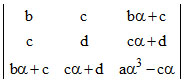 is equal to zero if
Options
A.b, c, d are in A.P.
B.b, c, d are in G.P.
C.b, c, d are in H.P.
D.α is a root of ax3 - bx2 - 3cx - d = 0
Solution
ᐃ = 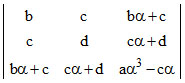
Applying C3 → C3 - (C1a + C2)
ᐃ =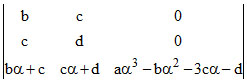 = 0
(aα3 - bα2 - 3cα - d) (bd - c2) = 0
∴ Either b, c, d in G.P. or α is root of ax3 - bx2 - 3cx - d = 0
Applying C3 → C3 - (C1a + C2)
ᐃ =
= 0 (aα3 - bα2 - 3cα - d) (bd - c2) = 0
∴ Either b, c, d in G.P. or α is root of ax3 - bx2 - 3cx - d = 0
Create a free account to view solution
View Solution FreeMore Determinant Questions
If the system of equations$${3x + y + 4z = 3 }{2x + \alpha y - z = - 3 }{X + 2y + z = 4 }$$has no solution, then the val...If A = , then AA′ is...If B is a non-singular matrix and A is a square matrix, then det (B-1 AB) is equal to...The determinant is equal to zero, if -...The determinant = 0, If...