DeterminantHard
Question
Let a, b > 0 and ᐃ =  , then
, thenOptions
A.a + b - x is a factor of ᐃ
B.x2 + (a + b)x + a2 + b2 - ab is a factor of ᐃ
C.ᐃ = 0 has three real roots if a = b
D.none of these
Solution
ᐃ = 
= (a + b - x)
Applying R2 → R2 - R1, R3 → R3 - R1
= (a + b - x)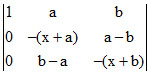
= (a + b - x) {(x + a) (x + b) + (a - b)2}
If a = b then (2a - x){(x + a)2} = 0
then x = - a, x = 2a
i.e., x is real.
= (a + b - x)
Applying R2 → R2 - R1, R3 → R3 - R1
= (a + b - x)
= (a + b - x) {(x + a) (x + b) + (a - b)2}
If a = b then (2a - x){(x + a)2} = 0
then x = - a, x = 2a
i.e., x is real.
Create a free account to view solution
View Solution Free