DeterminantHard
Question
If a, b, c are non zeros, then the system of equations
(α + a) x + αy + αz = 0
αx + (α + b)y + αz = 0
αx + αy + (α + c)z = 0
has a non-trivial solution if
(α + a) x + αy + αz = 0
αx + (α + b)y + αz = 0
αx + αy + (α + c)z = 0
has a non-trivial solution if
Options
A.α-1 = - (a-1 + b-1 + c-1)
B.α-1 = a + b + c
C.α a + a + b + c = 1
D.none of these
Solution
For non-trivial solution
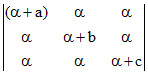 = 0
= 0
Taking a as common from each row
⇒ α3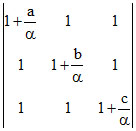 = 0
= 0
Applying C1 → C1 - C3, C2 → C2 - C3 and expanding
⇒ α3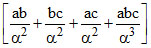 = 0
= 0
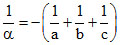
⇒
= 0 Taking a as common from each row
⇒ α3
= 0Applying C1 → C1 - C3, C2 → C2 - C3 and expanding
⇒ α3
= 0⇒
Create a free account to view solution
View Solution FreeMore Determinant Questions
If a ≠ b, then the system of equations ax + by + bz = 0, bx + ay + bz = 0, bx + by + az = 0 will have a non-trivia...Which of the following determinant(s) vanish(es)?...The equations x + 2y + 3z = 1, 2x + y + 3z = 2 and 5x + 5y + 9z = 4 have-...If f(x) = , then...If = λ then λ is equal to-...