DeterminantHard
Question
Let f(x) = 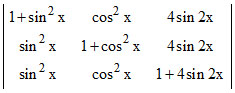 then the maximum value of f(x) is
Options
A.4
B.6
C.8
D.12
Solution
f(x) = 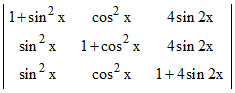
Applying C1 → C1 + C2 + C3
= (2 + 4 sin2x)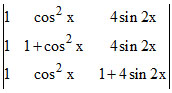
R2 → R2 - R1, R3 → R3 - R1
= (2 + 4 sin2x)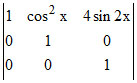
f(x) = (2 + 4sin 2x)
f(x)max = 6
Applying C1 → C1 + C2 + C3
= (2 + 4 sin2x)
R2 → R2 - R1, R3 → R3 - R1
= (2 + 4 sin2x)
f(x) = (2 + 4sin 2x)
f(x)max = 6
Create a free account to view solution
View Solution FreeMore Determinant Questions
If the system of linear equation x + ay + az = 0, x + by + bz = 0, x + cy + cz = 0 has a non-zero solution then...If a, b, c > 0 and x, y, z R, then the determinant is equal to -...For a non-zero real a, b and c = α abc, then the values of α is -...The determinant is equal to zero, then...For any ᐃABC, the value of determinant is -...