Complex NumbersHard
Question
Let E and F be two independent events. The probability that exactly one of them occurs is  and the probability of none of them occurring is
  . If P(T) denotes the probability of ocurrence of the event T, then
and the probability of none of them occurring is . If P(T) denotes the probability of ocurrence of the event T, thenOptions
A.P (E) = 4/5, P(F) = 3/5
B.P (E) = 1/5, P(F) = 2/5
C.P (E) = 2/5, P(F) = 1/5
D.P (E) = 3/5, P(F) = 4/5
Solution
Let P (E) = e and P (F) = f
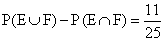
⇒ e + f - 2ef = ......(1)

⇒ (1 - e) (1 - f) =
⇒ 1 - e - f + ef = ......(2)
From (1) and (2)
ef = and e + f = 7/5.
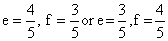
Solving, we get
⇒ e + f - 2ef =
......(1)⇒ (1 - e) (1 - f) =
⇒ 1 - e - f + ef =
......(2)From (1) and (2)
ef =
and e + f = 7/5.Solving, we get
Create a free account to view solution
View Solution FreeMore Complex Numbers Questions
If ω is cube root of unity, then the value of is-...Let and P = {wn : n = 1, 2, 3, .....}. Further and , where C is the set of all complex numbers. If and O represents the ...If z = x + i y then the equation of a straight line Ax + By + C = 0 where A, B, C ∈ R, can be written on the compl...The curve represented by Re(z2) = 4 is -...Let i = . The product of the real part of the roots of z2 - z = 5 - 5i is -...