Binomial TheoremHard
Question
The sum  (r + 1) Cr2 is equal to :
(r + 1) Cr2 is equal to :Options
A.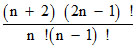
B.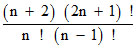
C.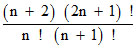
D.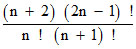
Solution
∵ (1 + x)n = C0 + C1x +.......+ Cnxn
Multiply by x & then differentiate
(1 + x)n + x. n(1 + x)n-1 = C0 + 2C1x +.........+ (n + 1)Cnxn ..........(i)
and (x + 1)n = C0xn + C1xn-1 +.......+ Cn .......(ii)
Multiply (i) & (ii) & equate the coefficient of xn on
both side
C02 + 2C12 + ........+ (n + 1) Cn2 = 2nCn + n. 2n-1Cn-1 =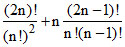 = (n + 2)
Multiply by x & then differentiate
(1 + x)n + x. n(1 + x)n-1 = C0 + 2C1x +.........+ (n + 1)Cnxn ..........(i)
and (x + 1)n = C0xn + C1xn-1 +.......+ Cn .......(ii)
Multiply (i) & (ii) & equate the coefficient of xn on
both side
C02 + 2C12 + ........+ (n + 1) Cn2 = 2nCn + n. 2n-1Cn-1 =
= (n + 2)Create a free account to view solution
View Solution FreeMore Binomial Theorem Questions
In the expansion of (71/3 + 111/9)6561, the number of terms free from radicals is:...If an = , then equals -...The term independent of y in the binomial expansion of is -...If in the expansion of ,the coefficient of third term is 31, then the value of n is-...Coefficient of x5 in 1-x231-x31-x41-x5 is...