Continuity and DifferentiabilityHard
Question
If x 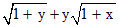 = 0, then
  is equal to
= 0, then is equal toOptions
A.
B.
C.
D.
Solution
x 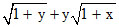 = 0
= 0
x2 (1 + y) = y2 (1 + x)
x2 - y2 + x2y - y2x = 0
(x + y) (x - y) + xy (x - y) = 0
(x - y) (x + y + xy) = 0
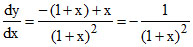
∵ x ≠ y ⇒ y = -
⇒
= 0x2 (1 + y) = y2 (1 + x)
x2 - y2 + x2y - y2x = 0
(x + y) (x - y) + xy (x - y) = 0
(x - y) (x + y + xy) = 0
∵ x ≠ y ⇒ y = -
⇒
Create a free account to view solution
View Solution Free