Continuity and DifferentiabilityHard
Question
Let g(x) be the inverse of an invertible function f(x) which is differentiable for all real x, then g″(f(x)) equals to
Options
A.
B.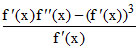
C.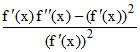
D.None of these
Solution
Given that g-1(x) = f(x)
⇒ x = g(f(x)) or g′(f(x)) f′(x) = 1
⇒ g′(f(x)) =
⇒ g″(f(x)) . f′(x) =
⇒ g″(f(x)) = -
⇒ x = g(f(x)) or g′(f(x)) f′(x) = 1
⇒ g′(f(x)) =
⇒ g″(f(x)) . f′(x) =
⇒ g″(f(x)) = -
Create a free account to view solution
View Solution Free