Continuity and DifferentiabilityHard
Question
If y = x(lnx)ln ln x, then  is equal to :
is equal to :Options
A. (2 ln ln x + 1)
(2 ln ln x + 1)B. (2 ln ln x + 1)
(2 ln ln x + 1)C. (2 ln ln x + 1)
(2 ln ln x + 1)D. None of these
Solution
y = x(lnx)ln ln x .......(i)
taking loge both sides, we get
lny = (ln x)ln (ln x) . lnx
Again taking loge , we get
ln (ln y) = ln (ln x) . ln (ln x) + ln (ln x)
= {ln (ln x)} [ln (ln x) + 1]
Diff. w.r.t. x,
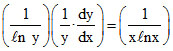 [ln (ln x) + 1] + {ln (ln x)}
⇒ = y lny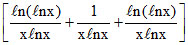
⇒ = y lny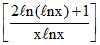
taking loge both sides, we get
lny = (ln x)ln (ln x) . lnx
Again taking loge , we get
ln (ln y) = ln (ln x) . ln (ln x) + ln (ln x)
= {ln (ln x)} [ln (ln x) + 1]
Diff. w.r.t. x,
[ln (ln x) + 1] + {ln (ln x)} ⇒
= y lny ⇒
= y lny Create a free account to view solution
View Solution FreeMore Continuity and Differentiability Questions
If fn (x) = efn-1(x) for all n ∈ N and fo (x) = x, then {fn (x)} is equal to...What is the value of (cos x)1/x at x = 0 so that it becomes continuous at x = 0 -...f′(x) = g(x) and g′(x) = - f(x) for all real x and f(5) = 2 = f′(5) then f2(10) + g2(10) is -...Let l = where m, n ∈ N then -...The number of points in the interval (0,2) where the derivative of the function f(x) = |x − 1/2| + |x − 1| +...