LimitsHard
Question
If α and β be the roots of equation ax2 + bx + c = 0, then  (1 + ax2 + bx + c)1/x-α is equal to
(1 + ax2 + bx + c)1/x-α is equal toOptions
A.a (α - β)
B.ln |a(α - β)|
C.ea(α - β)
D.ea|(α - β)|
Solution
α, β are the roots of the equation ax2 + bx + c = 0
∵ ax2 + bx + c = a(x - α)(x - β)
 (a + ax2 + bx + c)1/x-α =
 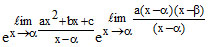 = ea(α - β)
∵ ax2 + bx + c = a(x - α)(x - β)
(a + ax2 + bx + c)1/x-α = = ea(α - β)Create a free account to view solution
View Solution Free