CapacitanceMedium
Question
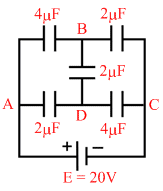
The figure shows a diagonal symmetric arrangement of capacitors and a battery. If the potential of C is zero, then (All the capacitors are initially uncharged).
Options
A.VA = + 20 V
B.4(VA − VB) + 2(VD − VB) = 2VB
C.2(VA − VD) + 2(VB − VD) = 4VD
D.VA = VB + VD
Solution
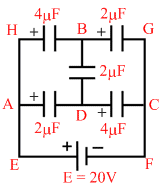
given VC = 0 in AEFC VA − 20 = VC ⇒ VA = 20 V Ans
by KCL, at point D
2 (VA − VD) + 2 (VB − VD) + 4 (VC − VD) = 0
2 (VA − VD) + 2 (VB − VD) = 4 VD ..... (i) Ans
by KCL, at point B
4 (VA − VB) + 2 (VD − VB) + 2 (VC − VB) = 0
4 (VA − VB) + 2 (VB − VD) = 2VB ........(ii) Ans
adding eq (i) and (ii)
2 (VA − VD) + 2 (VB − VD) + 4 (VA − VB) + 2 (VB − VD) = 4VD + 2 VB
⇒ 6VA = 6 VD + 6VB ⇒ VA = VD + VB
Create a free account to view solution
View Solution FreeMore Capacitance Questions
The energy stored in a condenser is in the form of-...N identical capacitor are joined in parallel and the combination is charged to a potential V. Now if they are separated ...n resistances each of resistance R are joined with capacitors of capacity C (each) and a battery of emf E as shown in th...In the given fig., if the heat flowing through the 5ω resistance is 10 calorie then how much heat is flowing throug...A parallel plate capacitor has a dielectric slab of dielectric constant K between its plates that covers 1/3 of the area...