FunctionHard
Question
If [2 cos x] + [sin x] = - 3, then the range of the function, f(x) = sin x + √3 cos x in [0, 2 π] is:
(where [. ] denotes greatest integer function)
(where [. ] denotes greatest integer function)
Options
A.[- 2, -1)
B.(- 2, - 1]
C.(- 2, -1)
D.[-2, -√3)
Solution
[2 cos x] + [sin x] = - 3
-2 ≤ 2 cos x ≤ 2 ⇒ [2 cos x] = 2, 1, - 1, - 2
- 1 ≤ sin x ≤ 1 ⇒ [sin x] = 1, 0, - 1
Equation holds true for [2 cos x] = - 2 and [sin x] = -1
⇒ - 1 ≤ cos x < - and - 1 ≤ sin x < 0
⇒ x ∈ and x ∈ (π, 2π)
⇒ x ∈
f(x) = sin x + √3 cos x
f(x) = 2 sin
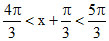
⇒ - 1 ≤ sin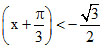
⇒ - 2 ≤ 2 sin < - √3
Hence range is [-2, -√3]
-2 ≤ 2 cos x ≤ 2 ⇒ [2 cos x] = 2, 1, - 1, - 2
- 1 ≤ sin x ≤ 1 ⇒ [sin x] = 1, 0, - 1
Equation holds true for [2 cos x] = - 2 and [sin x] = -1
⇒ - 1 ≤ cos x < -
and - 1 ≤ sin x < 0⇒ x ∈
and x ∈ (π, 2π)⇒ x ∈
f(x) = sin x + √3 cos x
f(x) = 2 sin
⇒ - 1 ≤ sin
⇒ - 2 ≤ 2 sin
< - √3Hence range is [-2, -√3]
Create a free account to view solution
View Solution FreeMore Function Questions
If f(x) = {4 − (x − 7)3}1/5, then its inverse is-...The domain where function f(x) = 2x2 − 1 and g(x) = 1 − 3x are equal, is-...The maximum value of the function f(x) = , x ∈ R is -...The functionf(x) = {2(t - 1) (t - 2)3 + 3(t - 1)2 (t - 2)2}dt attains its maximum at x is equal to :-...If f : R → R, g : R → R and g(x) = x + 3 and (fog) (x) = (x + 3)2, then the value of f(−3) is -...