FunctionHard
Question
The fundamental period of the function,
f(x) = x + a - [x + b] + sin πx + cos 2πx + sin 3πx + cos 4πx +...... + sin (2n - 1) πx + cos 2 nπx
for every a, b ∈ R is: (where [ ] denotes the greatest integer function)
f(x) = x + a - [x + b] + sin πx + cos 2πx + sin 3πx + cos 4πx +...... + sin (2n - 1) πx + cos 2 nπx
for every a, b ∈ R is: (where [ ] denotes the greatest integer function)
Options
A.2
B.4
C.1
D.0
Solution
f(x) = x + a - [x + b] + sin πx + cos 2πx + sin (3πx) + cos (4πx) + ........ + sin (2n - 1)π + cos (2πx)
f(x) = {x + b} + a - b + sin (πx) + cos (2πx) + sin (3πx) + cos (4πx) + .... + sin (2n - 1) + cos (2nπx)
Period of f(x) = L.C.M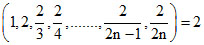
∴ period of f(x) = 2
since f(1 + x) ≠ f(x), hence fundamental period is 2
f(x) = {x + b} + a - b + sin (πx) + cos (2πx) + sin (3πx) + cos (4πx) + .... + sin (2n - 1) + cos (2nπx)
Period of f(x) = L.C.M
∴ period of f(x) = 2
since f(1 + x) ≠ f(x), hence fundamental period is 2
Create a free account to view solution
View Solution Free