FunctionHard
Question
If f(x) =  , then (fof) (x) = x, provided that
, then (fof) (x) = x, provided that Options
A.d + a = 0
B.d - a = 0
C.a = b = c = d = 1
D.a = b = 1
Solution
f(x) = 
fof(x) =
fof(x) =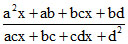
fof(x) =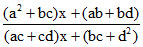 = x
= x
on comparing coefficient of both side (a2 + bc) x + (ab + bd) = (ac + cd) x2 + (bc + d2) x
a2 + bc = bc + d2 ⇒ a = d or a = - d
and ab + bd = 0 ⇒ b = 0 or a = - d
and ac + cd = 0 ⇒ c = 0 or a = - d
which can be simultaneously true for a = - d
fof(x) =
fof(x) =
fof(x) =
= xon comparing coefficient of both side (a2 + bc) x + (ab + bd) = (ac + cd) x2 + (bc + d2) x
a2 + bc = bc + d2 ⇒ a = d or a = - d
and ab + bd = 0 ⇒ b = 0 or a = - d
and ac + cd = 0 ⇒ c = 0 or a = - d
which can be simultaneously true for a = - d
Create a free account to view solution
View Solution FreeMore Function Questions
Solution of ≥ 3 is-...If f : R → [−1,1], f(x) = sin x, then f is -...Consider the function g(x) defined as g(x) (x(22011-1)-1) = (x + 1)(x2 + 1)(x4 + 1) . . .. (x22010 + 1) - 1, (|x| ≠...Function f(x) = is discontinuous at...For the functions $f(\theta) = \alpha\tan^{2}\theta + \beta\cot^{2}\theta$, and$g(\theta) = \alpha\sin^{2}\theta + \beta...