JEE Advanced | 2015Quadratic EquationHard
Question
Let S be the set of all non-zero numbers a such that the quadratic equation αx2 − x + a = 0 has two distinct real roots x1 and x2 satisfying the inequality |x1 − x2| < 1. Which of the following intervals is(are) a subset(s) of S ?
Options
A.
B.
C.
D.
Solution
α x2 - x + α = 0
D = 1 - 4α2
distinct real roots D > 0
⇒ α ∈ ...(i)
given |x1 - x2| < 1
⇒ < 1
< 1
⇒ 1 - 4α2 < α2
μ α ∈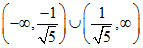 ...(ii)
from (i) & (ii)
α ∈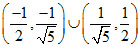
D = 1 - 4α2
distinct real roots D > 0
⇒ α ∈
...(i)given |x1 - x2| < 1
⇒
< 1⇒ 1 - 4α2 < α2
μ α ∈
...(ii)from (i) & (ii)
α ∈
Create a free account to view solution
View Solution FreeMore Quadratic Equation Questions
The roots of the equation (a + b − 2c) x2 − (2a − b - c) x + (a − 2b+ c) = 0 are -...If $ax^{2} + bx + 8 = 0,a,b \in R,a \neq 0$ has no distinct real roots, then the least value of $4a + b$ is...The number of real roots of the equation $\sqrt{|1 - x|} = kx$, where $k$ is a parameter is...If < 6, x ∈ R, then -...If the roots of the equation are reciprocal to each other, then -...