JEE Advanced | 2015Set, Relation and FunctionHard
Question
Let ƒ, g : [−1, 2] →  be continuous function which are twice differentiable on the interval (−1, 2). Let the values of ƒ and g at the points −1, 0 and 2 be as given in the following table :
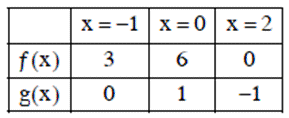
In each of the intervals (−1, 0) and (0, 2) the function (ƒ − 3g)″ never vanishes. Then the correct statement(s) is(are)
be continuous function which are twice differentiable on the interval (−1, 2). Let the values of ƒ and g at the points −1, 0 and 2 be as given in the following table :In each of the intervals (−1, 0) and (0, 2) the function (ƒ − 3g)″ never vanishes. Then the correct statement(s) is(are)
Options
A.ƒ′(x) − 3g′(x) = 0 has exactly three solutions in (−1, 0) ∪ (0, 2)
B.ƒ′(x) − 3g′(x) = 0 has exactly one solution in (−1, 0)
C.ƒ′(x) − 3g′(x) = 0 has exactly one solutions in (0, 2)
D.ƒ′(x) − 3g′(x) = 0 has exactly two solutions in (−1, 0) and exactly two solutions in (0, 2)
Solution
Let F(x) = ƒ(x) − 3g(x)
∴ F(−1) = 3; F(0) = 3 & F(2) = 3
∴ F′(x) will vanish at least twice in (−1,0) ∪ (0, 2)
∵ F″(x) > 0 or < 0 ∀ x ∈ (−1,0) ∪ (0, 2)
so there will be exactly 9 solution in (−1,0) and one in (0, 2)
∴ F(−1) = 3; F(0) = 3 & F(2) = 3
∴ F′(x) will vanish at least twice in (−1,0) ∪ (0, 2)
∵ F″(x) > 0 or < 0 ∀ x ∈ (−1,0) ∪ (0, 2)
so there will be exactly 9 solution in (−1,0) and one in (0, 2)
Create a free account to view solution
View Solution FreeMore Set, Relation and Function Questions
Let f: → be a function given by f(x) = max(sinx, tan2x). Identify the correct statement(s) -...Let f : N → Y be a function defined as f (x) = 4x + 3, where Y = {y ∈ N : y = 4x + 3 for some x ∈ N}. ...Consider the following relations:R = {(x, y) | x, y are real numbers and x = wy for some rational number w}; S = m, n, p...The mean of the data set comprising of 16 observations is 16. If one of the observation valued 16 is deleted and three n...The domain of the function f(x) = is...