Application of DerivativeHard
Question
Let f(x) = 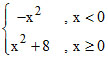
Equation of tangent line touching both branches of y = f(x) is
Equation of tangent line touching both branches of y = f(x) is
Options
A.y = 4x + 1
B.y = 4x + 4
C.y = x + 4
D.y = x + 1
Solution
Let y = mx + c be tangent touching both branches.
f(x) = - x2, y = mx + c , x < 0
x2 + mx + c = 0, m > 0 (∵ x < 0 ) (negative roots)
D = 0 ⇒ m2 = 4c
f(x) = x2 + 8, y = mx + c, x > 0
x2 - mx + 8 - c = 0, m > 0 (positive roots)
D = 0 ⇒ m2 = 32 - 4c
⇒ c = 4, m2 = 16 ⇒ c = 4, m = 4
f(x) = - x2, y = mx + c , x < 0
x2 + mx + c = 0, m > 0 (∵ x < 0 ) (negative roots)
D = 0 ⇒ m2 = 4c
f(x) = x2 + 8, y = mx + c, x > 0
x2 - mx + 8 - c = 0, m > 0 (positive roots)
D = 0 ⇒ m2 = 32 - 4c
⇒ c = 4, m2 = 16 ⇒ c = 4, m = 4
Create a free account to view solution
View Solution FreeMore Application of Derivative Questions
The equation of the normal to the curve x = at2, y = 2at at ′t′ point is-...At any point of a curve is equal to -...Let f(x) = xm/n for x ∈ R where m and n are integers, m even and n odd and 0 < m < n. Then...The surface area of a spherical bubble is increasing at the rate of 2 cm2/s. When the radius of the bubble is 6 cm, then...The coordinates of the point on the curve y = x2 + 3x + 4 the tangent at which passes through the origin are-...