Reproduction in OrganismEasy
Question
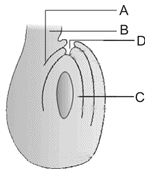
The given figure shows a typical anatropous ovule. What do A, B, C & D represents.
Options
A.A → Hilum, B → Funicle, C → Nucellus, D → Micropyle
B.A → Hilum, B → Outer integument, C → Nucellus, D → Micropyle
C.A → Hilum, B → Outer integument, C →Embryosac, D → Micropyle
D.None of these
More Reproduction in Organism Questions
Mature male gametophyte of Angiosperm is...Double fertilization and triple fusion were discovered by...An ovule which becomes curved so that the nucellus and embryo sac lie at right angles to the funicle is...Functions of sepals in a flower are -...In a grafted plant, stock has 48 chromosomes while scion has 24 chromosomes. The chromosome number for root cells and eg...