Differential EquationEasy
Question
Let f (x) be a polynomial of degree four having extreme values at x = 1 and x = 2. If  = 3, then f (2) is equal to :
= 3, then f (2) is equal to :Options
A.0
B.4
C.- 8
D.- 4
Solution
Clearly f(x) = ax4 + bx3 + cx2 + dx + e
Now,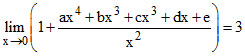
∴ Clearly d = e = 0
Now, (1 + ax2 + bx + c) = 3
∴ c = 2
hence,
f(x) = ax4 + bx3 + 2x2
∴ f′(x) = 4ax3 + 3bx2 + 4x
= x(4ax2 + 3bx + 4)
Now, x = 1 and x = 2 are also solutions
∴ 3 = and 2 =
  ⇒ a =
⇒ a =  and b = - 2
∴ f(x) = - 2x3 + 2x2
f(2) = 8 - 16 + 8 = 0
Now,
∴ Clearly d = e = 0
Now,
(1 + ax2 + bx + c) = 3∴ c = 2
hence,
f(x) = ax4 + bx3 + 2x2
∴ f′(x) = 4ax3 + 3bx2 + 4x
= x(4ax2 + 3bx + 4)
Now, x = 1 and x = 2 are also solutions
∴ 3 =
and 2 = ⇒ a = and b = - 2∴ f(x) =
- 2x3 + 2x2f(2) = 8 - 16 + 8 = 0
Create a free account to view solution
View Solution FreeMore Differential Equation Questions
The solution of the differential equation y dx + (x + x2y) dy = 0 is...The solution of the equation = 0 is-...The slope of the tangent at (x, y) to a curve passing through is given by − cos2 , then the equation of the curve ...The solution of the differential equation = (1 + x) (1 + y2) is-...Solution of the differential equation x = 1 + xy is-...