Trigonometric EquationHard
Question
In a triangle PQR ∠R = , if tan
 and tan
 are the roots of the equation ax2 + bx + c = 0(a ≠ 0), then
, if tan and tan are the roots of the equation ax2 + bx + c = 0(a ≠ 0), then Options
A.a + b = c
B.a + b = c
C.a + c = b
D.b = c
Solution
It is given that tan (P / 2) and tan (Q / 2) are the roots of the quadratic equation
ax2 + bx + c = 0 and ∠R = π / 2
∴ tan (P / 2) + tan (Q / 2) = - b / a
and tan (P / 2) tan (Q / 2) = c / a
Since, P + Q + R = 180o
⇒ P + Q = 90o
⇒ = 45o
= 45o
⇒ tan = tan 45o
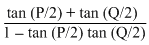
⇒
⇒ = 1
= 1
⇒ = 1 ⇒
= 1 ⇒  = 1
= 1
⇒ - b = a - c
⇒ a + b = c
ax2 + bx + c = 0 and ∠R = π / 2
∴ tan (P / 2) + tan (Q / 2) = - b / a
and tan (P / 2) tan (Q / 2) = c / a
Since, P + Q + R = 180o
⇒ P + Q = 90o
⇒
= 45o⇒ tan
= tan 45o⇒
⇒
= 1⇒
= 1 ⇒ = 1⇒ - b = a - c
⇒ a + b = c
Create a free account to view solution
View Solution FreeMore Trigonometric Equation Questions
If A and B be acute positive angles satisfying 3 sin2 A + 2 sin2B = 1 and 3 sin2A - 2 sin2B = 0. then-...If 2 tan2 θ = sec2 θ, then the general solution of θ -...Let $0 < \alpha < 1,\beta = \frac{1}{3\alpha}$ and $\tan^{- 1}(1 - \alpha) + \tan^{- 1}(1 - \beta) = \frac{\pi}{4}...The distance, from the origin, of the normal to the curve, x = 2 cos t + 2t sin t, y = 2 sin t − 2t cos t at t =&#...The value of is-...