Laws of MotionEasy
Question
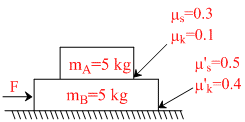
Which of the following statements is / are CORRECT for the figure shown.
Options
A.The magnitude of limiting frictional force on mass A is 15 N.
B.The magnitude of limiting frictional force between mass B and ground is 100 N.
C.Force F is increasing continuously, maximum acceleration of A is 3 m/s2.
D.Force F is increasing continuously, when sliding starts between block A and B, the minimum acceleration of B relative to A is 2 m/s2.
Solution
Static limiting frictional force on mass A = μS mAg = 0.3 × 5 × 10 = 15 N
Static limiting frictional force on mass B = μ′B (mA + mB)g = 0.5 × (5 + 15) 10 = 100 N
After the block A start sliding, for the motion of mass A uk mA g = mAaA ⇒ aA = μkg = 0.1 × 10 = 1 m/s2
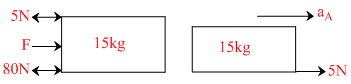
and F = 80 N + (15 + 5) × 3 = 140 N
aA = 1 m/s2 & aB = m/s2
Static limiting frictional force on mass B = μ′B (mA + mB)g = 0.5 × (5 + 15) 10 = 100 N
After the block A start sliding, for the motion of mass A uk mA g = mAaA ⇒ aA = μkg = 0.1 × 10 = 1 m/s2
and F = 80 N + (15 + 5) × 3 = 140 N
aA = 1 m/s2 & aB =
m/s2Create a free account to view solution
View Solution FreeMore Laws of Motion Questions
Two blocks of masses 6 kg and 4 kg are connected by a rope of mass 2 kg are resting on a frictionless floor as shown in ...A block of mass m resting on a wedge of angle θ as shown in the figure. The wedge is given an acceleration a toward...Three masses of 1 kg, 6 kg and 3 kg are connected to each other with threads and are placed on a table as shown in figur...A block A of mass m is placed over a plank B of mass 2m. Plank B is plank over a smooth horizontal surface. The coeffici...In the fig. given below masses m and m′ are tied with a thread passing over a pulley, m′ is on a frictionles...