Wave motionEasy
Question
Following are equations of four waves
(i) y1 = a sin ω
(ii) y2 = a cos ω
(iii) z1 = a sin ω
(iv) z2 = a cos ω
Which of the following statements is/are CORRECT?
(i) y1 = a sin ω
(ii) y2 = a cos ω
(iii) z1 = a sin ω
(iv) z2 = a cos ω
Which of the following statements is/are CORRECT?
Options
A.On superposition of waves (i) and (iii), a travelling wave having amplitude a√2 will be formed.
B.Superposition of waves (ii) and (iii) is not possible.
C.On superposition of waves (i) and (ii), a transverse stationary wave having maximum amplitude a√2 will be formed.
D.On superposition of waves (iii) and (iv), a transverse stationary wave will be formed.
Solution
Superposition of waves (i) & (iii) will give travelling wave having amplitude of a√2
{waves are along x-axis but particle displacements are along y & z-axis respectively}
z1 + z2 = a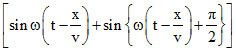
{waves are along x-axis but particle displacements are along y & z-axis respectively}
z1 + z2 = a
Create a free account to view solution
View Solution FreeMore Wave motion Questions
A 1m long wire having tension T is fixed at A and free at B. The point C, 20 cm from B is constrained to be stationary. ...One end of a taut string of length 3 m along the x-axis is fixed at x = 0. The speed of the waves in the string is 100 m...What is the path different for destructive interference ?...A progressive wave of frequency 500 Hz is travelling with a velocity of 360 m/sec. How far apart are two point, which ha...Wave of frequency 100 Hz travels along a string towards its fixed end. When this wave travels back, after reflection a n...