Home
>
Math
>
Limits
Limits
Easy
Question
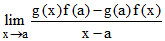
If f(a) = 3, f′ (a) = − 2, g(a) = − 1, g′ (a) = 4, then
equals-
Options
A.
− 5
B.
10
C.
− 10
D.
5
Solution
-
Create a free account to view solution
View Solution Free
Topic:
Limits
·
Practice all Limits questions
More Limits Questions
If 0 < x < y, then (yn + xn)1/n is equal to-...
The function f(x) = sin-1 (cos x) is:...
is equal to -...
The value of x1/x is-...
If f: R → R be a differentiable function, such that f(x + 2y) = f(x) + f(2y) + 4xy ∀ x, y ∈ R . then...
 equals- equals- equals-