Application of DerivativeMedium
Question
Let f(x) = ∫ ex(x - 1)(x - 2)dx. Then f decreases in the interval
Options
A.(- ∞, -2)
B.(- 2, -1)
C.(1, 2)
D.(2, ∞)
Solution
Let f(x) = ∫ex(x - 1)(x - 2)dx.
⇒ f′(x) = ex (x -1)(x - 2)
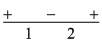
∴ f′(x) < 0 for 1 < x < 2
⇒ f(x) is decreasing for x ∈ (1, 2)
⇒ f′(x) = ex (x -1)(x - 2)
∴ f′(x) < 0 for 1 < x < 2
⇒ f(x) is decreasing for x ∈ (1, 2)
Create a free account to view solution
View Solution FreeMore Application of Derivative Questions
Water is poured into an inverted conical vessel of which the radius of the base is 2 m and height 4 m, at the rate of 77...The abscissa of the point, where the tangent to the curve y2 = 4a { x + a sin (x/a)} is parallel to x- axis is-...If curves = 1 and = 1 intersect orthogonally, then-...The curve y = f(x) which satisfies the condition f′ (x) > 0 and f′′ (x) < 0 for all real x, is:...Which of the following statements are true :...